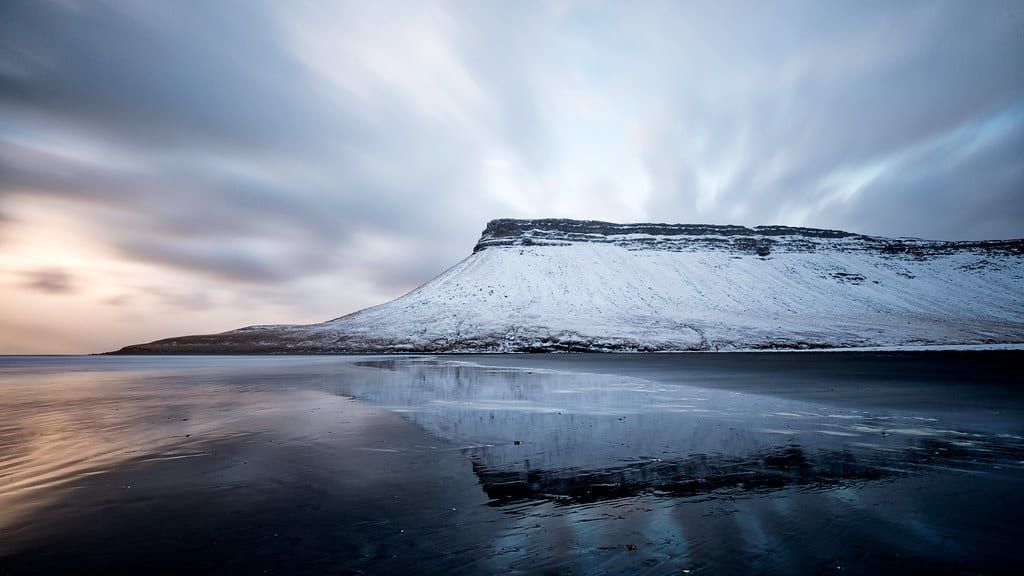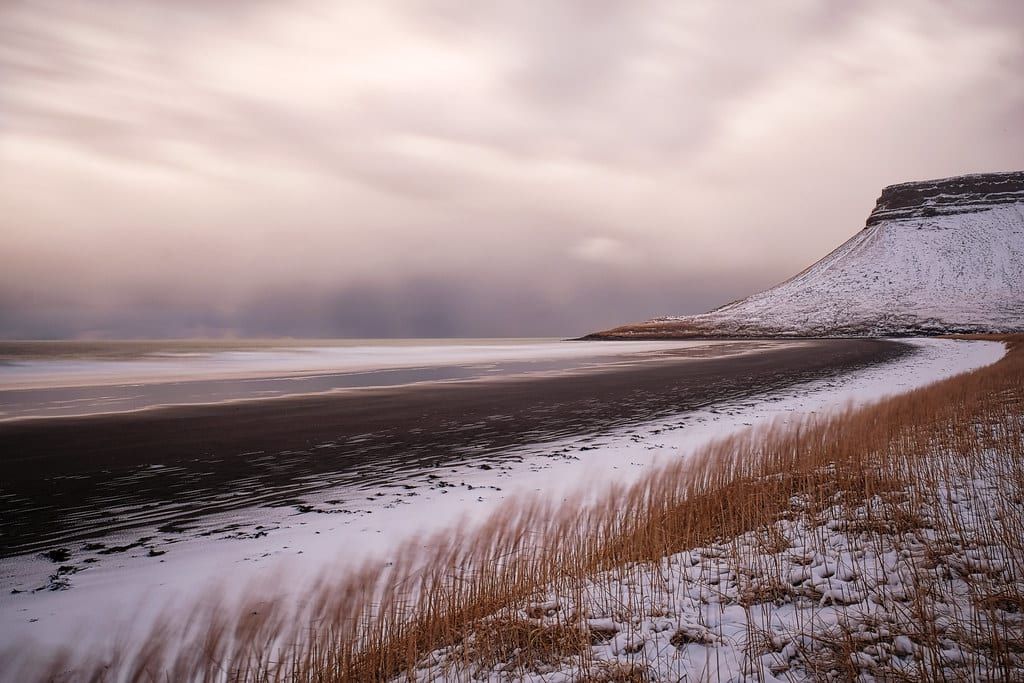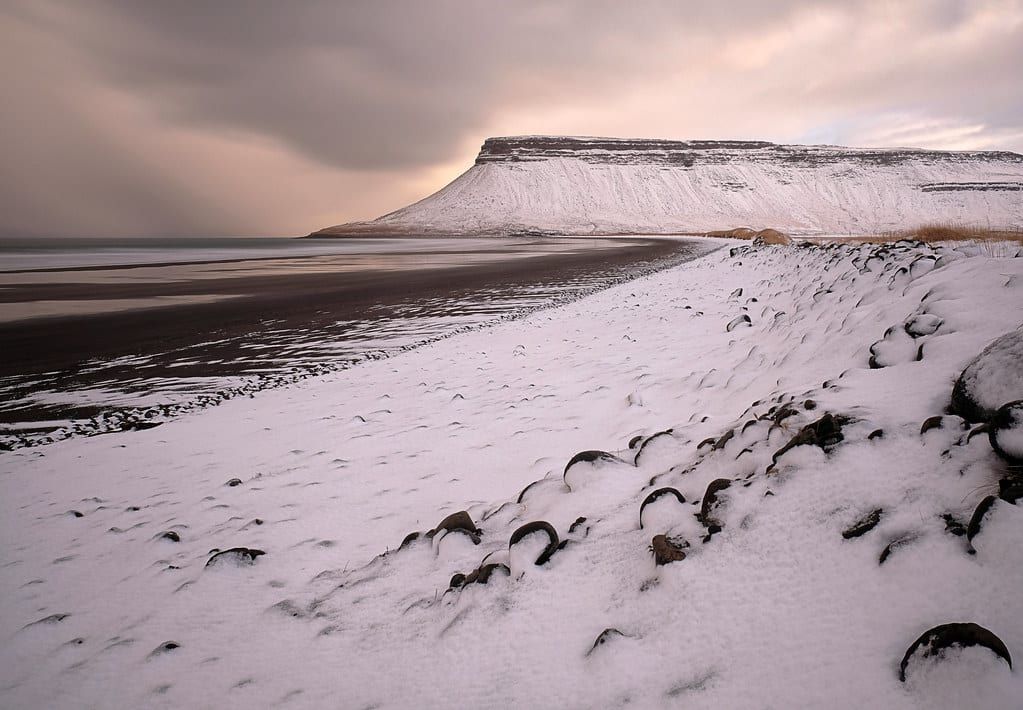
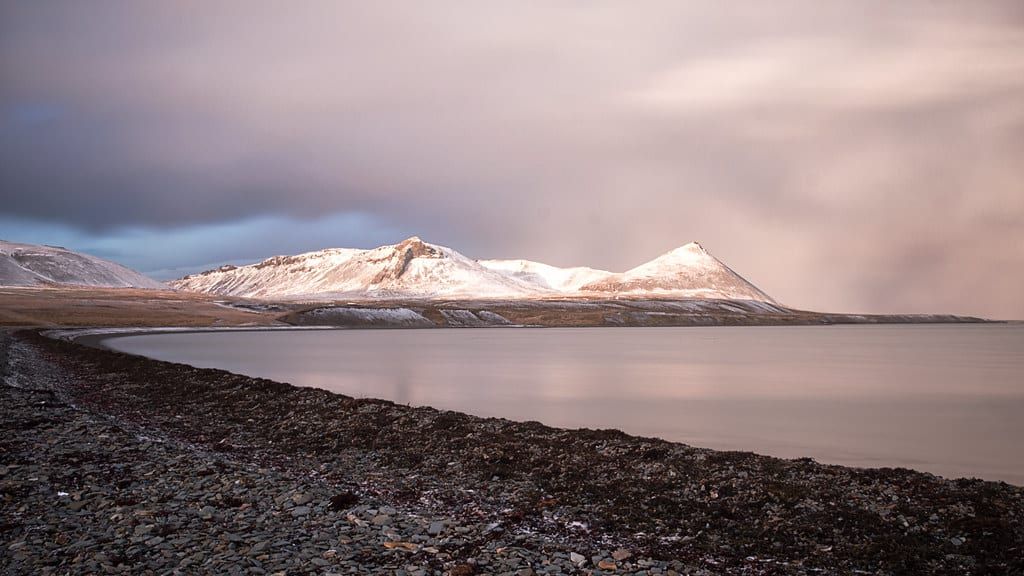
Yes — Snæfellsnes is genuinely one of the best places in Iceland to watch the northern lights, and on a clear night your main problem will be choosing a foreground, not finding the sky. The aurora itself comes from solar particles striking the atmosphere, but what makes or breaks a viewing spot is darkness, latitude and room to move. This peninsula scores on all three.
Most of Snæfellsnes sits at Bortle 2–3 on the dark-sky scale — genuinely dark — while Reykjavík reads 7–8, washed out by streetlight. Even Kirkjufellsfoss, the waterfall beside Iceland's most photographed mountain, is unlit. And at 64.9°N the peninsula sits well inside the auroral oval, so modest geomagnetic activity still hangs a green arc over the ocean rather than hugging a distant horizon. Add a two-hour drive from Reykjavík and you have the shortest route from the capital to proper darkness. If you're planning a wider trip, our guide to things to do on the peninsula covers the daytime half of the visit.
Why Snæfellsnes Delivers Some of Iceland's Best Aurora Nights
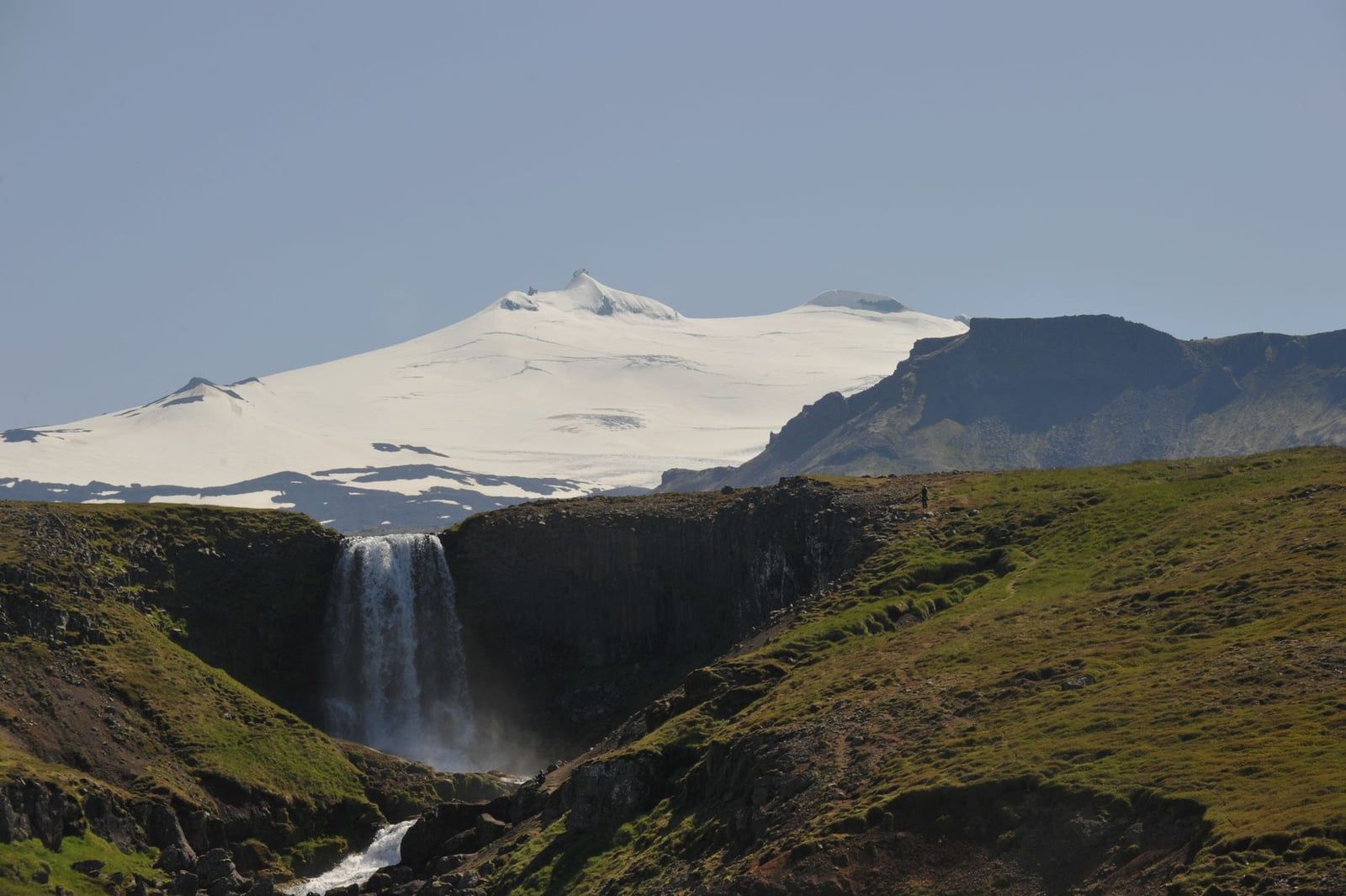
Dark skies are the peninsula's quiet advantage. Between the small towns — Grundarfjörður, Ólafsvík, Arnarstapi — the countryside is empty enough that your headlights are often the only lights for miles. The peninsula runs about 90 km west into the Atlantic, and at its tip the 1,446 m glacier-capped Snæfellsjökull volcano gives you a foreground no aurora bus stop in the south can copy. Black-pebble beaches, sea stacks, a stepped waterfall: the 'Iceland in miniature' nickname was earned for daytime scenery, but it works at 11 p.m. under a green sky too.
Crowds are the other half of the pitch. The Golden Circle and south-coast aurora runs can mean a dozen cars at every layby; on Snæfellsnes you'll frequently share a viewpoint with two. Winter is still winter — November through March brings snow, ice, and only 5–7 hours of daylight — but that's the trade for nights this dark.
When to See the Northern Lights in Snæfellsnes (Month by Month)
The season runs from late September to mid-April. Within that window, the months are far from equal, and the right choice depends on whether you're optimising for darkness, weather or drivable roads.
September–October. The season opens properly in late September, and the equinox gives it a push: NASA and NOAA data show auroral activity in March–April and September–October runs roughly twice as high as around the solstices, an effect tied to how the solar wind couples with Earth's magnetic field at equinox. Temperatures are milder, the roads are usually ice-free, and you can hunt the aurora before deep winter arrives. Early September also means thinner crowds than July and August. This is the comfortable pick.
November–December. Darkness stretches toward its maximum — up to about 20 hours around the 21 December solstice — and daytime shrinks to 4–6 hours. Statistically, though, December and January are the weakest months for geomagnetic activity and the stormiest for weather, with average daytime temperatures around 0°C and cold snaps to −10°C. You get enormous night; you also get the year's hardest driving. For what winter on the peninsula actually feels like beyond the aurora, see our guide to Snæfellsnes in winter.
February–March. Local guides' favourite window. The nights are still long, activity climbs back toward its equinox peak, and February and March often bring more stable weather than midwinter. The trade-off is ice: Route 54 can be glazed for weeks at a time, and you'll want a 4x4 with winter tires.
April. The tail of the season. From mid-April the sky no longer goes fully dark, and faint displays fade into the twilight. Go early in the month or not at all.
May–August. Impossible. From May to mid-August the midnight sun keeps the sky bright all night, and there is nothing to hunt.
One more planning lever: the moon. Book your dates around the new-moon week where you can. A full moon washes out weaker displays across a landscape that has no other light source, though a strong storm — Kp 5 and up — will cut through moonlight regardless. Check a lunar calendar before you fix your week.
How to Read the Forecast and Chase Clear Skies on the Peninsula
Here's the sequence local guides actually use, in order: wind forecast first, then precipitation, then the cloud-cover map on the Icelandic Met Office site, en.vedur.is. The Met Office aurora page shows cloud cover as a map — white means clear, green means cloud — alongside a 0–9 activity scale, and it only looks about three days ahead, so treat anything beyond tomorrow as a rough guide.
On the cloud map, switch to the composite view and look at all three layers. Low cloud kills a night; high cloud very often has gaps you can work with. That distinction matters more than the Kp number. At 64.9°N, Kp 2–3 on a clear, dark night is enough for a visible green arc — local guides generally don't even go out unless Kp is above 2, and anything higher is a bonus. A Kp 6 storm behind solid cloud is worth nothing. Cloud is the enemy on this peninsula; chase it, don't fight it.
Chasing means using the terrain. When low cloud blankets the coast, drive to the lee side of a mountain, where the air descends and clouds dissipate — the stretch between Arnarstapi and Hellissandur along the national park coast is the classic run, hunting for gaps with the aurora overhead. If you're new to reading the sky, this is exactly what a guided outing does for you.
Timing is simpler. Displays are typically visible from about 9 p.m. to 2 a.m., with the true peak around midnight; at Kirkjufell the statistical sweet spot is 22:00–01:00. Activity can spike at any dark hour, though, so if the sky is clear and the forecast is decent, be out rather than in.
Before you drive anywhere, open road.is. Route 54 is paved the whole way to Grundarfjörður but exposed to wind on the peninsula's south side, and it closes in storms. For last-minute checks, Hello Aurora (Iceland-made, with live user reports), My Aurora Forecast & Alerts and NOAA's 30-minute Aurora Forecast map cover the gap between forecast and sky.
Best Places to See the Northern Lights in Snæfellsnes
The peninsula's spots split into two groups: the north side around Grundarfjörður — closest to Reykjavík — and the national-park coast at the western tip, about 200 km out and darker still. Distances below are from Reykjavík; figure 2.5 hours in summer, 3–3.5 in winter to Grundarfjörður. That's a long night round trip, which is why the where-to-stay advice later in this guide matters. If you're weighing the whole peninsula against other Icelandic aurora bases, a Snæfellsnes day trip from Reykjavík article breaks down the driving in detail.
Kirkjufell and Kirkjufellsfoss
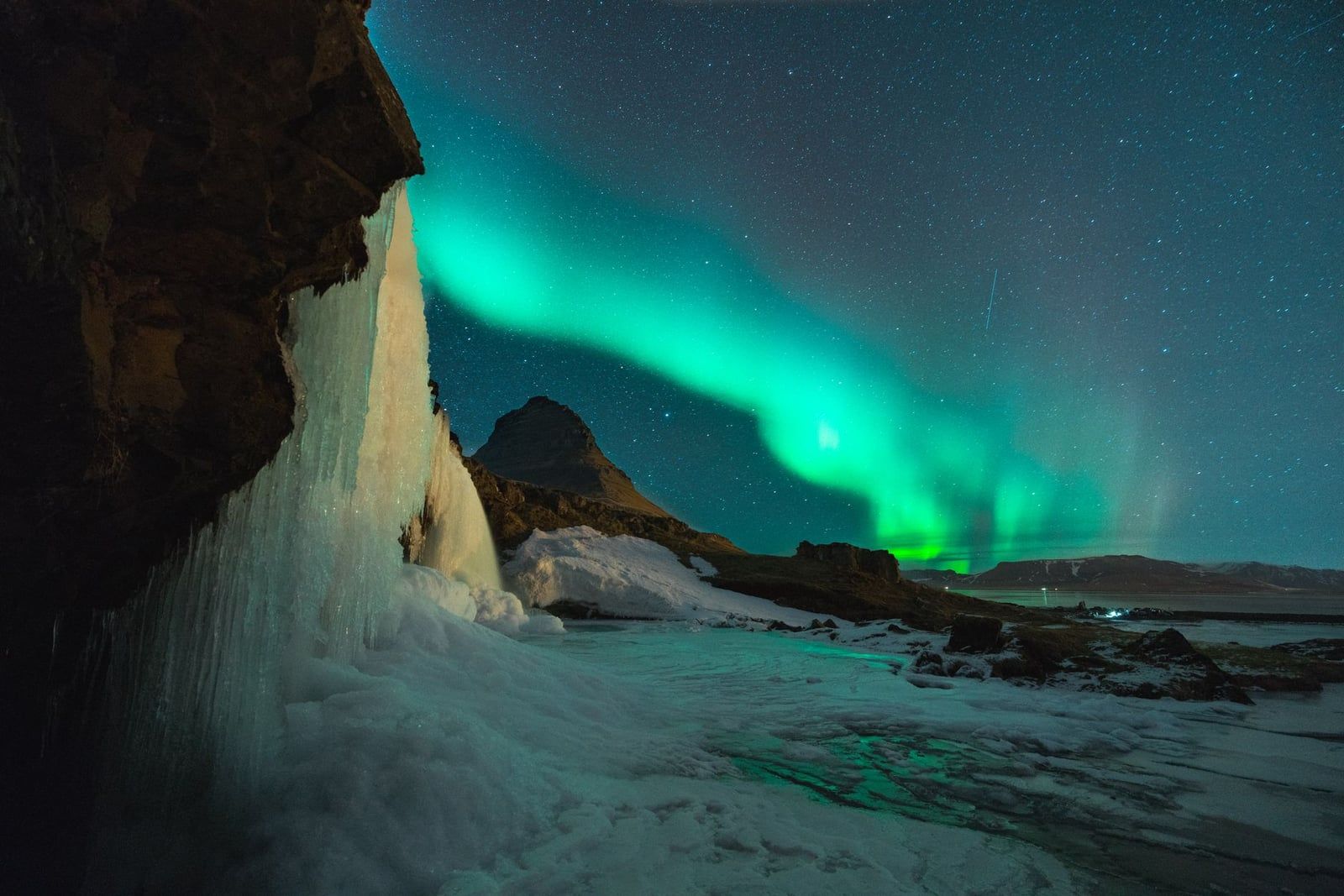
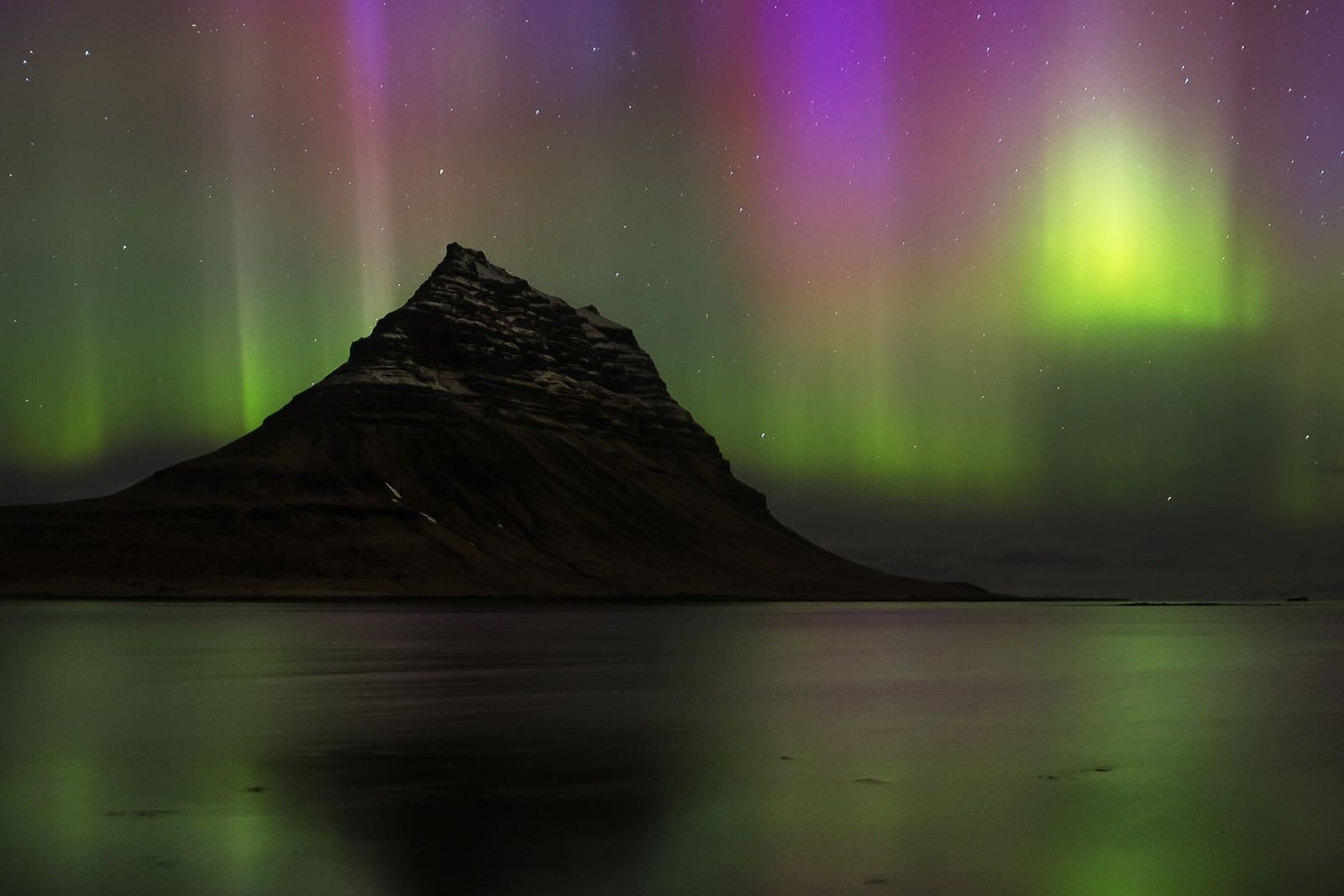
The 463 m arrowhead above Grundarfjörður is the shot. Park at the Kirkjufellsfoss pull-off on Route 54, roughly 1 km west of town — a dirt lot that holds about 15 cars — and walk two minutes to the falls. The classic composition is from the second footbridge, with the three-tiered waterfall in the foreground and the peak behind it; when the aurora sits directly over the summit, it's the most photographed night scene in Iceland for a reason. Kirkjufell is about 180 km from Reykjavík. Two warnings: the path to the falls freezes solid from November to March, and climbing the mountain itself is prohibited (explicitly so from November to mid-June) — climbers have died on it. If clouds cap the peak, fall back to Grundarfjörður harbour, where the same sky sits over quiet water.
Arnarstapi and Hellnar
Two old fishing villages joined by a sea-cliff path, about 200 km from Reykjavík on the south side of the peninsula. The Gatklettur stone arch is the foreground most photographers come for, and the aurora reflecting off flat coastal water doubles whatever the sky is doing. The cliff-top between the villages is a demanding 2.5 km walk in daylight; at night, treat it as out of bounds and stay near the village ends. The path down to the beach at Arnarstapi is steep and dark — headlamp, and red mode if others are shooting.
Djúpalónssandur
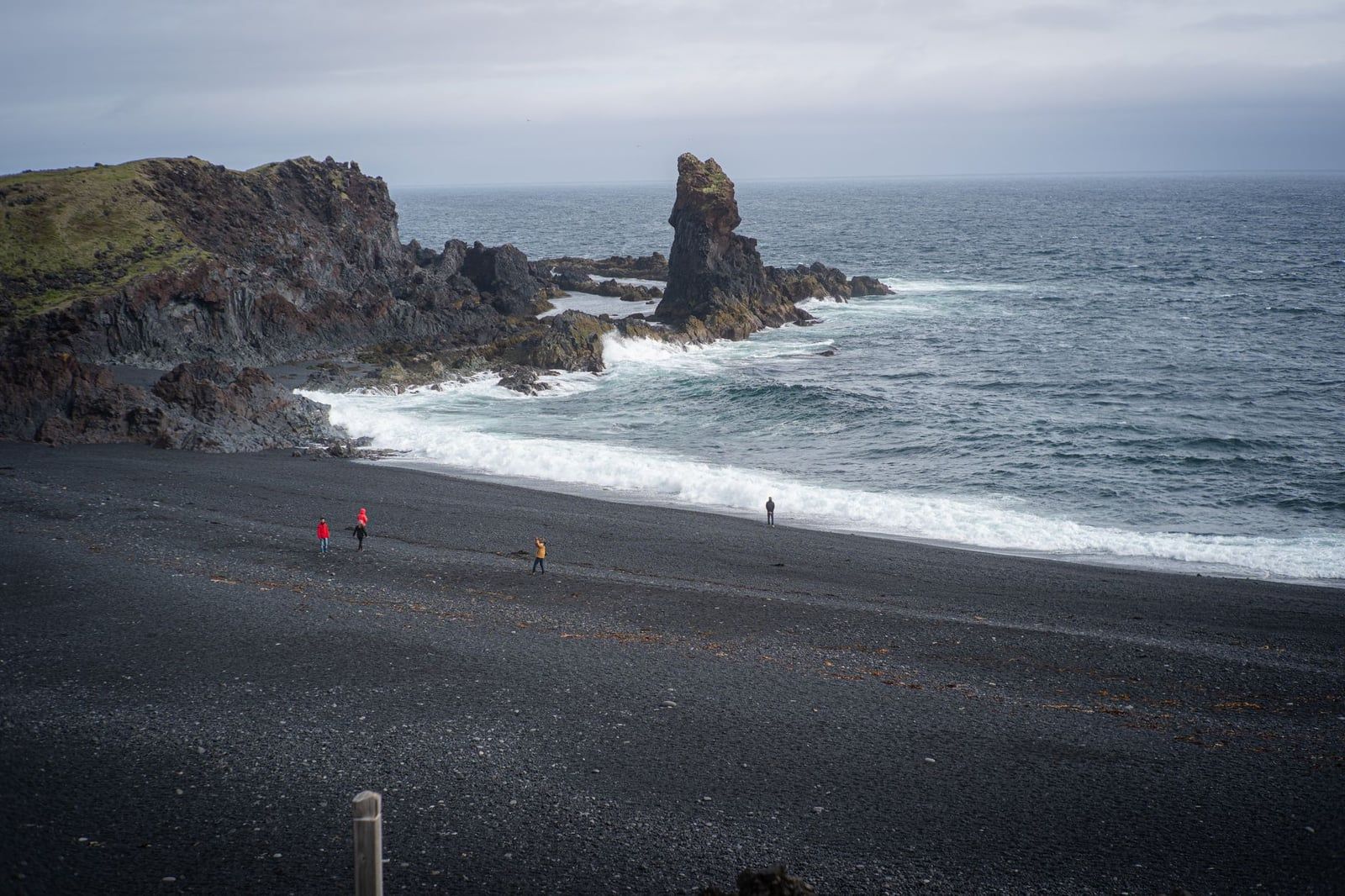
A black-pebble beach set in a lava amphitheatre at the western tip, about 200 km from Reykjavík — the farthest spot in this guide and one of the darkest, with some of the lowest light pollution on the peninsula. You reach it through a gap in the cliffs; on the beach lie the four historic lifting stones and the rusting wreck of the British trawler Epine, lost here in 1948. The wreck is also the warning: sneaker waves at Djúpalónssandur are notoriously large and unpredictable, swimming is forbidden, and you should never turn your back on the ocean or approach the waterline. Shoot from the upper beach, well back.
Lóndrangar and Malarrif
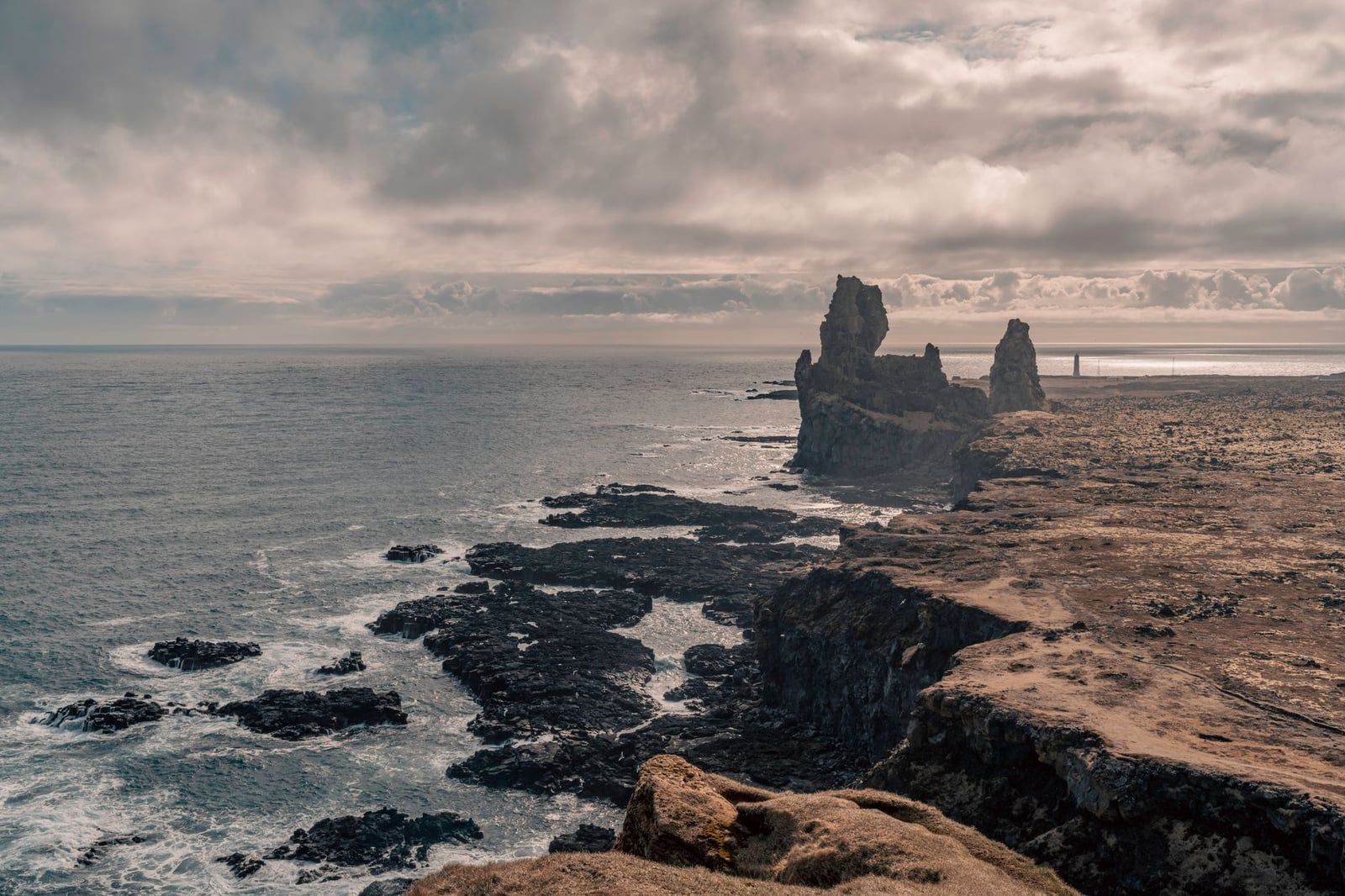
Two basalt sea stacks — 75 m and 61 m, the remains of an ancient volcanic plug — rise out of the surf a short drive from Djúpalónssandur, with the Malarrif lighthouse behind them. The horizon here is open ocean in every direction, which is exactly what you want when a strong display climbs overhead into a corona. The Malarrif visitor centre has 24/7 restrooms, a small mercy at midnight in February.
Snæfellsjökull National Park viewpoints
The park covering the peninsula's western end holds the darkest skies of all, particularly around Vatnshellir Cave and Djúpalónssandur, and the horizons are wide enough that a low arc over the north is easy to catch. Lesser-known backdrops like Hreggnasi give locals their quiet nights when Kirkjufell's lot is full. Practical note for aurora drivers: parking inside the national park costs ISK 1,100 per car, paid via the Parka app or a QR code, and one payment is valid until midnight across every park lot. If you want a daytime warm-up under the same volcano, the Vatnshellir lava cave tour runs year-round.
Selvallafoss
The inland option: a waterfall on the northern slopes of the Vatnaheiði pass, overlooking Lake Selvallavatn and the red lava fields of northern Snæfellsnes, with a parking lot right on the highway. It suits a night when the coastal strip is socked in but the sky inland is clearing — the same lee-side logic the guides use, applied to a map. The drive in from Route 54 is short but exposed; check the wind before committing.
Self-Drive or Guided Tour — and Where to Base Yourself
Most aurora nights on Snæfellsnes are self-driven, and that's the right call if you're comfortable on winter roads. The payoff is flexibility: when the composite cloud map shows a gap 40 km west, you just drive there, and you can wait out a slow-building night on your own schedule. The requirements are real, though. Icelandic law requires headlights on 24 hours a day year-round; rental cars carry winter (often studded) tires in the cold months; and a 4x4 is strongly recommended once ice arrives. Wind gusts on the open peninsula can shove a car half a lane. Check routes and transport options and road.is before any night drive.
A guided tour trades that flexibility for expertise and a passenger seat. Local guides read the peninsula's microclimates the way anglers read water, and if an outing is cancelled or unsuccessful, companies typically offer a second attempt free. What doesn't work well is a northern-lights day tour from Reykjavík: the peninsula's spots sit 170–200 km out, and an aurora hunt tacked onto an 11-hour coach day leaves you driving home at 2 a.m. Multi-day trips that sleep in the region make far more sense. You can compare options across Snæfellsnes tours or narrow it to tours from Reykjavík.
| Self-drive | Guided tour | |
|---|---|---|
| Flexibility | Full — you chase cloud gaps wherever they open | The guide decides; they know the microclimates |
| Night driving | You, on winter roads at night | None — you ride and watch |
| Forecasting | Your forecast-reading (see the section above) | Professional forecasting and cloud-chasing |
| If the night fails | Try again the next night yourself | Usually a free second attempt |
| Best for | Confident winter drivers, photographers with gear | Anyone uneasy about ice, wind or planning |
Whichever you choose, sleep on the peninsula. A 3 a.m. return drive to Reykjavík after a display ends is the single worst decision available on this itinerary — the same ice and wind you drove out in, plus fatigue. Basing in Grundarfjörður puts you a two-minute drive (or a walk) from Kirkjufell with the harbour as a cloud fallback; Ólafsvík and Hellissandur sit closest to the national park's dark coast; Arnarstapi and Hellnar put you on the sea cliffs. Rural guesthouses are the pick when the aurora is the point — some offer a wake-up call when the lights appear, which beats setting alarms all night. Our full where to stay in Snæfellsnes guide covers the towns and properties.
And give yourself 2–3 nights in the region, minimum. There is never a guarantee of seeing the northern lights — a clear sky, dark hours and the right solar wind have to line up, and sometimes they simply don't. Multiple nights is the only reliable strategy anyone can offer you.
How to Photograph the Northern Lights (and What They Really Look Like)
You need a tripod and a camera with manual control; everything else is settings and cold-weather housekeeping. Focus manually to infinity, or focus in live view on a bright star and lock it there. Start around f/2.8–f/4, ISO 800–3200, and a 5–20 second exposure; when the lights are moving fast, shorten the shutter to freeze them. At Kirkjufell specifically, typical successful exposures run 4–15 seconds at f/2.8 and ISO 1600–3200.
Cold drains batteries fast — carry spares in an inside pocket, not the camera bag. Coastal wind will shake a light tripod, so weight the hook or brace it. Phones can genuinely work now: night mode on a modern iPhone holds up to 30-second exposures, but only on a tripod, and only if you've practised before the sky delivers. One etiquette rule with real consequences: use a red headlamp. A white beam from 50 metres away washes straight into everyone's long exposures and destroys the night vision you spent 20 minutes building.
Now the expectation check. Aurora strength varies enormously. A few nights a year bring vivid pink, white and green displays that are unmistakable to the naked eye; far more often you'll see a grey-green band that your camera renders far more brilliantly than your eyes do. That's not a disappointment — a long exposure gathers light for seconds while your eye works in real time — but walk in knowing the Instagram version is a minority report. Photographer Iurie Belegurschi, who shoots Iceland for a living, names Kirkjufell as his favourite aurora location in the country. That's the ceiling; be happy with the floor.
Practical Tips and Safety for Your Aurora Night
Dress for standing still, not for hiking. An insulated parka and boots, windproof layers, and thin liner gloves under mitts so you can work camera controls without bare fingers. Aurora watching is 90 minutes of cold punctuated by five minutes of frantic joy, and the cold is the part people underestimate.
On the ground, a few rules keep the night from going wrong:
- Micro-spikes over boots from November to March — the Kirkjufellsfoss path freezes solid.
- Visit a new spot in daylight first to learn the layout.
- Never turn your back on the surf; sneaker waves at Djúpalónssandur are killers.
- Park only where it's safe and legal, never on road shoulders around blind curves.
- Fill up at Borgarnes — the last reliable fuel stop heading west.
- Tell someone your route before you leave.
Once you're positioned, get away from the town lights and look north: displays usually begin high above the northern horizon as a pale arc. Then wait. If activity strengthens, the belt climbs toward the zenith and can break into a corona directly overhead — the most dramatic vantage the sky offers, and worth every cold minute you spent for it.
Northern Lights in Snæfellsnes: FAQs
The short answers to the questions that come up again and again when travellers plan an aurora trip to the peninsula.
Frequently asked questions
When is the best time to see the northern lights in Snæfellsnes?
Late September to mid-April, with September and March statistically the strongest months — equinox activity runs roughly double the solstice months. February and March often bring the most stable weather, while December and January give up to 20 hours of darkness but stormier skies. Plan 2–3 nights in the region for real odds.
What Kp index do you need on Snæfellsnes?
Less than you'd think. At 64.9°N, Kp 2–3 on a clear, dark night is enough for a visible display — local guides don't usually go out below Kp 2. Cloud cover matters far more than the Kp number: even a Kp 5 storm is invisible behind cloud.
Where is the best place to stand at Kirkjufell?
From the Kirkjufellsfoss pull-off about 1 km west of Grundarfjörður: a 2-minute walk to the falls, with the classic composition from the second footbridge. The path freezes solid November–March, so bring micro-spikes. If clouds cap the mountain, shoot from Grundarfjörður harbour instead.
Can you see the northern lights in Snæfellsnes without a tour?
Yes — self-driving is the standard approach and gives you the freedom to chase cloud gaps. You'll want a 4x4 with winter tires, headlights on (legally required around the clock), and a road.is check before leaving. Guided tours suit anyone uneasy about winter night driving and usually include a free retry if the night fails.
How far is Snæfellsnes from Reykjavík, and is one night enough?
Depending on the spot, 170–200 km — about 2.5 hours to Grundarfjörður in summer, 3–3.5 in winter. A single night is possible, but the late-night winter return drive is risky; staying overnight in the region is the smarter plan.
What time of night are the lights most visible?
Typically between 9 p.m. and 2 a.m., with the statistical peak at 22:00–01:00 and the strongest displays often around midnight. Stay flexible — activity can spike at any dark hour.
Can you see the northern lights in Snæfellsnes in summer?
No. The midnight sun keeps the sky bright from May to mid-August, and the sky stops going fully dark from mid-April. The season properly reopens in late September.
Do the northern lights look as good as the photos?
Sometimes, rarely. A few nights a year deliver vivid multi-colour corona displays clearly visible to the naked eye, but weak displays look dimmer in person than in long-exposure photos — cameras gather light in a way your eye can't. And the lights are never guaranteed on any given night.